
OPD, Call and WhatsApp: Mon–Sat, 10 AM–8 PM (Sunday closed)

Online consultations across India and abroad

Category: Allergy Guides

  • Chronic Cough (ઉધરસ) and Allergic Bronchitis: When a Long-Lasting Cough Needs a Proper Look

    Chronic Cough (ઉધરસ) and Allergic Bronchitis: When a Long-Lasting Cough Needs a Proper Look

    A cough that hangs on for weeks can leave you tired and unsure what to do next. Many people in Gujarat simply call it ઉધરસ.

    This guide covers what “long-lasting” can mean, common reasons a cough may continue, why a proper look matters (including general TB advice in India when symptoms fit), and how Allergy Cure Clinic may help people who have lived with a long-lasting cough or breathing allergy for a long time. It is general information, not a personal diagnosis. Results vary. Please do not stop or change any prescribed medicine or inhaler without talking to your doctor.

    Our clinic does not treat emergencies or sudden severe attacks. For severe or sudden breathing problems, call 108 right away.

    What counts as a long-lasting (chronic) cough?

    Many everyday coughs settle on their own within about 3 to 4 weeks.[1]

    Woman coughing into her elbow at home with a long-lasting cough, tissues and water nearby

    As a rough guide only:

    • If a cough lasts more than 3 weeks, get medical advice rather than waiting and wondering.[1][3]
    • Many specialist guidelines call a cough chronic in adults when it lasts more than 8 weeks.[2]

    Duration alone does not tell you the cause. You cannot safely self-diagnose from a webpage.

    Common reasons a cough can hang on (not a DIY diagnosis)

    These are patterns clinicians consider — not labels to give yourself:

    • After a cold or bronchitis — many improve over about 3 weeks. Antibiotics are not routinely needed for many coughs.[1][3]
    • Asthma or cough-dominant patterns — cough, wheeze, chest tightness, or shortness of breath, sometimes worse at night or early morning.[4][6] Specialists may describe cough-variant or asthmatic cough patterns.[2] See our allergic asthma guide and allergic asthma page.
    • Nose allergy and mucus drip — mucus from the back of the nose can trigger cough; allergic rhinitis can sit alongside breathing problems.[1][8] See our allergic rhinitis guide.
    • Acid reflux — a cough that keeps returning, sour taste, or hoarse voice, often after meals or when lying down.[7]
    • Smoking — a common cause of ongoing cough.[1]
    • Some blood-pressure medicines — a dry, persistent cough can be a side effect of ACE-inhibitor tablets such as ramipril.[9][2] Do not stop prescribed medicines on your own.
    • Tuberculosis (TB) — important in India — Anyone with a cough lasting two weeks or more, especially with fever, night sweats, weight loss, or blood in phlegm, should get checked for TB at a government health centre or by their doctor.[14][15][13] This is general public-health advice, not a clinic service.

    Why a proper assessment matters

    A long cough is often not dangerous — but it can be a clue to asthma, infection, reflux, medicine side effects, or TB. Signs that suggest a specific disease should always be investigated properly.[2]
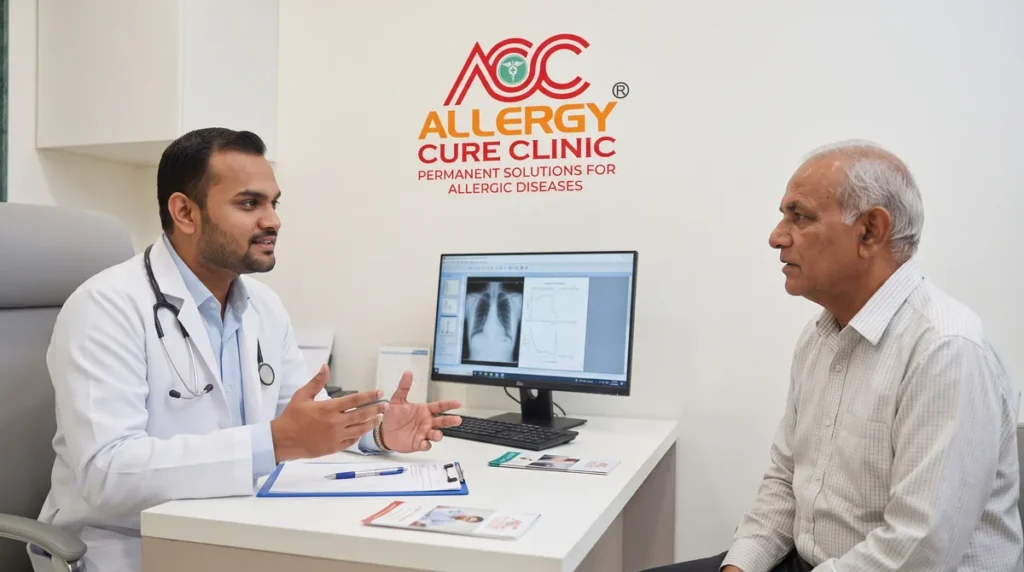
    Dr. Ashish B. Dungrani, BHMS, MD (New Delhi), PGDEMS (Mumbai), Advance Diploma in Allergy & Clinical Immunology, Consultant Homoeopathic Physician, Allergist & Immunologist, discussing a long-lasting cough with a patient at Allergy Cure Clinic Surat

    If your cough has lasted two weeks or more with fever, weight loss, night sweats, or blood in phlegm, get checked for TB through your doctor or a government health centre.[14][15]

    How Allergy Cure Clinic can help

    Allergy Cure Clinic is for people who have lived with a long-lasting cough or breathing allergy for a long time, feel tired of relying on medicine, and want a long-term approach through modern immunotherapy and personalised treatment. Feeling tired of medicine does not mean you should stop or change prescribed medicines or inhalers on your own — always talk to your doctor first. Results vary.

    This modern immunotherapy is the clinic’s own approach. The doctor explains it at your consultation. It is not the same as guideline allergen immunotherapy (allergy shots or tablets), and this article makes no claims about how well it works.

    Care begins with clinical assessment at the main clinic in Katargam, Surat: when the cough started, what makes it better or worse, sleep and work impact, nose or reflux symptoms, smoking, medicines you use, and any warning signs.[1][2][5]

    When clinically appropriate, the clinic may also offer:

    • a pulmonary function test (PFT) — a lung function test — done at the Surat centre or arranged through partnered testing labs (not at visiting centres)[10][11]
    • IgE blood testing

    The IgE test offered here cannot, on its own, identify individual triggers or diagnose allergy. A clinician interprets this test alongside your symptoms and medical history.[12]

    Learn more: chronic cough care at our clinic, pulmonary function test (PFT), and asthma breathing care.

    Visiting centres across Gujarat (including Ahmedabad, Vadodara, Ankleshwar and Bharuch) and online consultation are also available — see locations.

    What is a pulmonary function test (PFT)?

    A lung function test checks how well your lungs are working. The most common type is spirometry: you take a deep breath and blow hard into a mouthpiece so the device can measure how much air you blow out and how fast.[10][11]
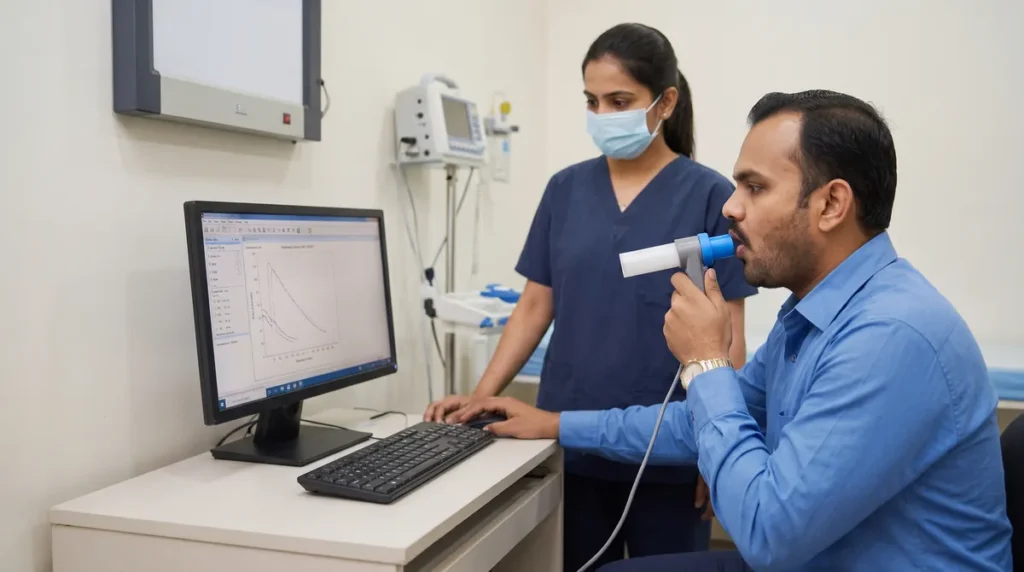
    Patient doing a pulmonary function test (spirometry) with a clinic assistant at Allergy Cure Clinic Surat

    You may sit with a soft clip on your nose and repeat the blow a few times. Sometimes you use an inhaler and repeat the test after a short break.[11] Results need a clinician to explain them.

    At Allergy Cure Clinic, this test is done at the Surat centre or arranged through partnered testing labs — not at the visiting centres.

    When to get help

    Use the groups below as a guide. When in doubt, seek medical help sooner.

    Our clinic does not treat emergencies or sudden severe attacks. For severe or sudden breathing problems, call 108 right away.

    Call 108 now if you have

    In Gujarat, 108 is listed as an ambulance helpline.[16]

    Call 108 if:[3][4][5]

    • you are struggling to breathe, choking, gasping, or cannot speak in full sentences
    • your lips, tongue, gums or skin look blue, grey, or unusually pale (on brown or black skin this may be clearer on the palms, lips, tongue, gums, under the nails, or around the eyes)
    • you suddenly feel confused or unusually sleepy with severe breathing trouble
    • you are coughing up large amounts of blood, or have severe chest pain with breathing difficulty

    Do not wait to book a clinic visit in those situations.

    Seek same-day urgent care from your doctor or the nearest hospital (not this clinic) if you have

    • a cough that is very bad or quickly getting worse, you feel very unwell, or you find it hard to breathe[1]
    • chest pain with coughing or breathing[1][3]
    • coughing up blood or blood-stained mucus[1][3][13]
    • a known asthma pattern that is not settling with your usual emergency plan (if you have one)[4]

    Arrange prompt medical review (not “wait and see”) if you have

    • a cough lasting more than 3 weeks that is not improving[1][3]
    • a cough lasting two weeks or more, especially with fever, night sweats, weight loss, or feeling generally unwell — get checked for TB at a government health centre or by your doctor[14][15][13]
    • unexplained weight loss, night sweats, or ongoing fever with cough[13][14]
    • you are a smoker (or ex-smoker) and your cough has changed
    • a new or lasting hoarse voice with cough[7]
    • you take an ACE-inhibitor blood-pressure tablet and a dry cough will not settle — speak to the prescribing doctor[9]

    Book a routine consultation at Allergy Cure Clinic if you have

    • lived with a long-lasting cough or breathing allergy for a long time
    • feel tired of relying on medicine and want to discuss a long-term, personalised approach (do not stop prescribed medicines without your doctor)
    • night cough or returning allergy-type breathing symptoms without emergency or same-day urgent features
    • questions about clinical assessment, a lung function test (Surat centre or partnered lab), or IgE blood testing

    Visit the main clinic in Katargam, Surat, use visiting centres across Gujarat, or book an online consultation.

    Common questions

    Is a long cough always allergy?

    No. Infection, asthma, reflux, smoking, medicines, and TB all need to be considered.[1][2]

    When should I get checked for TB?

    As general public-health advice in India: if your cough lasts two weeks or more, especially with fever, weight loss, night sweats, or blood in phlegm, get checked for TB at a government health centre or by your doctor.[14][15][13]

    Should I stop my inhalers or tablets before I come in?

    No. Do not stop or change prescribed medicines or inhalers on your own — even if you feel tired of relying on medicine. Bring a list of what you take.

    Will an IgE test tell me my exact triggers?

    No. The IgE test offered here cannot, on its own, identify individual triggers or diagnose allergy. Your clinician interprets it with your symptoms and history.[12]

    What results can I expect?

    Many people look for better control and relief with a personalised long-term plan. Outcomes differ from person to person. This article does not promise a cure. Results vary.

    Take the next step

    If you have lived with a long-lasting cough or breathing allergy for a long time, feel tired of relying on medicine, and want to discuss a long-term approach through modern immunotherapy and personalised treatment — and your symptoms are not an emergency — you can book a consultation. Do not stop or change prescribed medicines without your doctor. Results vary. Our team will call you back to confirm your visit.

    Our clinic does not treat emergencies or sudden severe attacks. For severe or sudden breathing problems, call 108 right away.

    Main clinic: Katargam, Surat. Visiting centres across Gujarat and online consultation are also available.

    This page is for education. It does not replace personal medical advice.

    References

    1. [1] NHS. Cough. https://www.nhs.uk/conditions/cough/
    2. [2] ERS Task Force (Morice et al.). ERS guidelines on the diagnosis and treatment of chronic cough in adults and children. Eur Respir J 2020;55:1901136. PMC: https://pmc.ncbi.nlm.nih.gov/articles/PMC6942543/
    3. [3] NHS. Bronchitis. https://www.nhs.uk/conditions/bronchitis/
    4. [4] NHS. Asthma. https://www.nhs.uk/conditions/asthma/
    5. [5] ICMR / MoHFW. Standard Treatment Workflow — Asthma (PDF). https://www.icmr.gov.in/icmrobject/uploads/STWs/1725952329_pulmonology_asthma.pdf
    6. [6] WHO. Asthma fact sheet. https://www.who.int/news-room/fact-sheets/detail/asthma
    7. [7] NHS. Heartburn and acid reflux. https://www.nhs.uk/conditions/heartburn-and-acid-reflux/
    8. [8] AAAAI (patient). Hay Fever / Rhinitis. https://www.aaaai.org/conditions-treatments/allergies/hay-fever-rhinitis
    9. [9] NHS. Side effects of ramipril. https://www.nhs.uk/medicines/ramipril/side-effects-of-ramipril/
    10. [10] MedlinePlus (U.S. NLM). Lung Function Tests. https://medlineplus.gov/lab-tests/lung-function-tests/
    11. [11] NHS. Spirometry. https://www.nhs.uk/tests-and-treatments/spirometry/
    12. [12] MedlinePlus (U.S. NLM). Allergy Blood Test. https://medlineplus.gov/lab-tests/allergy-blood-test/
    13. [13] NHS. Tuberculosis (TB). https://www.nhs.uk/conditions/tuberculosis-tb/
    14. [14] Central Tuberculosis Division, MoHFW (India) — FAQs. https://tbcindia.mohfw.gov.in/faqs/
    15. [15] Central Tuberculosis Division / TB Mukt Bharat Abhiyan guidance (PDF). https://tbcindia.mohfw.gov.in/wp-content/uploads/2025/09/Guidance-Document-on-TB-Mukt-Bharat-Abhiyan_0.pdf
    16. [16] Ahmedabad District, Government of Gujarat (NIC). Helpline. https://ahmedabad.nic.in/helpline/

  • Allergic Rhinitis (Nose Allergy): Symptoms, Triggers and Care

    Sneezing that keeps coming back. A blocked or runny nose. Itchy eyes. Many people in Gujarat call this એલર્જી શરદી — a “cold” that never seems to leave.

    It may be allergic rhinitis (nose allergy or hay fever). This guide covers common signs, how they can differ from a short viral cold or sinus problems, what the IgE test offered here can and cannot show, and when to get help. It is general information, not a personal diagnosis. Results vary. Please do not stop any prescribed medicine without talking to your doctor.

    What is allergic rhinitis?

    Allergic rhinitis happens when your immune system reacts to something you breathe in — an allergen — and the lining of your nose becomes irritated.[1][2]

    Common symptoms include sneezing; an itchy nose; a runny or blocked nose; itchy, red or watery eyes; an itchy roof of the mouth; and sometimes a cough.[1]

    Symptoms often start soon after you meet a trigger.[1] Some people notice them in certain seasons; others feel them for much of the year.[2]

    Allergic rhinitis, a viral cold, or sinus problems?

    These can feel similar. You cannot safely self-diagnose from a webpage. A clinician uses your story — and sometimes an exam or tests — to sort them out. As a rough guide only:

    Viral cold (common cold)

    A cold is usually viral. It often settles over days to about two weeks. You may also feel generally unwell for a short burst of illness.[3]

    Allergic rhinitis

    Allergy symptoms often last longer, return with the same trigger, and may include a very itchy nose or eyes. Itching of the nose or eyes is less typical of a simple cold pattern.[1][2][4]

    Sinusitis (sinus inflammation)

    Sinusitis is inflammation of the lining of the air spaces around the nose. It often follows a cold. Clues can include pain, swelling or tenderness around the cheeks, eyes or forehead, and a blocked or runny nose that is slow to improve.[5]

    Many acute sinus problems are viral, not bacterial. Antibiotics are not routinely needed for many people with sinusitis.[5][4]

    If you are unsure — or symptoms are severe or not improving — see a doctor rather than guessing.

    Allergens vs irritants

    Allergens can set off an immune (allergic) response in people who are sensitised — for example pollen, house dust mites, mould or animal dander.[1][2]

    Irritants are different. Smoke, strong odours, dusty air, and sudden changes in temperature or humidity can make a sensitive nose feel worse. That does not always mean you are “allergic” to smoke itself.[2][4]

    Cutting down allergen exposure where you can, and avoiding irritants such as tobacco smoke, helps many people feel more comfortable.[1][2][4] Results vary.

    How allergic rhinitis is assessed

    Good care starts with a detailed clinical history (and usually an examination): when symptoms began, what makes them better or worse, sleep or work impact, other allergy or breathing problems, and medicines you already use.[1][4]

    Dr. Ashish B. Dungrani, BHMS, MD (New Delhi), PGDEMS (Mumbai), Advance Diploma in Allergy & Clinical Immunology, Consultant Homoeopathic Physician, Allergist & Immunologist, taking an allergy history at Allergy Cure Clinic Surat

    At Allergy Cure Clinic in Katargam, Surat, care begins with clinical assessment. The clinic offers IgE blood testing. Not everyone needs testing.

    If you also wheeze, feel short of breath, or have known asthma, tell the clinician. Allergic rhinitis and asthma often travel together.[4][6] See our allergic asthma guide.

    What can the IgE test offered here tell you?

    IgE is an antibody linked to allergic-type responses.[7] The IgE test offered here cannot, on its own, identify individual triggers or diagnose allergy. A clinician interprets this test alongside your symptoms and medical history.[7][8]

    Whether you need this test is a clinical decision. See the clinic’s IgE blood test information page, then discuss it with your clinician.

    Care that can help

    Evidence-based care for allergic rhinitis often includes:[1][2][4]

    • avoiding or reducing triggers where you reasonably can
    • medicines such as antihistamines and corticosteroid (steroid) nasal sprays, chosen with a pharmacist or doctor
    • decongestant nose sprays only as advised, and usually only for a short time — longer use can worsen blockage for some people[1][4]

    This guide does not give doses or a personal medicine plan. If you already use prescribed sprays, tablets or inhalers, do not stop them unless your doctor asks you to.

    Salt-water (saline) nose rinsing — water safety

    Salt-water sprays or rinses can help clear the nose for some people with rhinitis.[1][2][4]

    If you use a rinse or irrigation device, water safety matters. Use only distilled water, sterile water, or tap water boiled for 3–5 minutes and then cooled.[9]

    Do not use untreated tap water in the nose.[9] Prefer a ready-made saline product or your device’s / pharmacist’s instructions. This article does not give a homemade salt-mixing recipe.

    When to get help

    Use the groups below as a guide. When in doubt, seek medical help sooner.

    Call 108 (ambulance / emergency response) or go to emergency care now if you have

    In Gujarat and across much of India, 108 is the dial number for emergency ambulance response.[10][11]

    Call 108 (or use the nearest emergency department) if:[12][13][6]

    • your lips, mouth, throat or tongue suddenly swell, or your throat feels tight / you struggle to swallow
    • you are breathing very fast, struggling to breathe, or cannot speak in full sentences
    • your skin, tongue or lips look blue, grey or unusually pale, or you feel faint, confused, or collapse with a severe allergic-type reaction
    • you think you are having a severe asthma attack and symptoms are not improving with your usual emergency plan (if you have one)

    Do not wait to book a routine clinic visit in those situations.

    Seek emergency or same-day urgent care (do not treat as a routine booking) if you have

    • eye pain, sudden vision loss or double vision, or eyes that are very sensitive to light with a red eye — these need prompt clinical assessment, not a “book later” approach[14]
    • sudden severe swelling around the eyes or face with breathing or swallowing trouble (overlap with the 108 list above)[12]
    • sinus or face symptoms with being very unwell, pain that is getting rapidly worse, or a weakened immune system[5]

    Arrange prompt medical review (clinician / ENT pathway — not “wait and see”) if you have

    These problems are often not an immediate ambulance call on their own, but they should be checked without long delay:[15][4]

    • stuffiness or blockage mainly on one side of the nose that does not go away
    • repeated nosebleeds or mucus from the nose that is bloody, especially with one-sided blockage
    • a lump or growth on the face, nose or roof of the mouth that does not go away

    Most people with these symptoms do not have cancer — but they still need proper examination.[15]

    Book a routine consultation if you have

    • sneezing, runny or blocked nose, or itchy eyes that keep returning
    • symptoms that disturb sleep, work or school
    • you rely on pharmacy medicines often and want a clearer plan
    • you want to discuss whether assessment or IgE blood testing is appropriate

    You can visit Allergy Cure Clinic in Katargam, Surat, or use an online consultation when travel is hard. Learn more about allergic rhinitis and sinus allergy care.

    Common questions

    Can allergic rhinitis be cured?

    Many people can get better control and relief with the right plan. Outcomes differ. This article does not promise a cure or permanent result. Results vary.

    Should I stop my tablets or nasal spray before I come in?

    No — do not stop prescribed medicines on your own. Bring a list of what you take.

    Will an IgE test tell me everything?

    No. The IgE test offered here cannot, on its own, identify individual triggers or diagnose allergy. Your clinician interprets this test alongside your symptoms and medical history.[7][8]

    Take the next step

    If your symptoms are not an emergency, you can book a consultation. Our team will help you confirm a visit.

    Main clinic: Katargam, Surat. Online consultation is also available.

    This page is for education. It does not replace personal medical advice.

    References

    1. [1] NHS. Allergic rhinitis. https://www.nhs.uk/conditions/allergic-rhinitis/
    2. [2] AAAAI. Hay Fever / Rhinitis. https://www.aaaai.org/conditions-treatments/allergies/hay-fever-rhinitis
    3. [3] NHS. Common cold. https://www.nhs.uk/conditions/common-cold/
    4. [4] AAAAI/ACAAI Joint Task Force. Rhinitis 2020: A practice parameter update. J Allergy Clin Immunol. 2020;146:721–767. https://www.aaaai.org/Aaaai/media/Media-Library-PDFs/Allergist%20Resources/Statements%20and%20Practice%20Parameters/Rhinitis-2020-A-practice-parameter-update.pdf
    5. [5] NHS. Sinusitis. https://www.nhs.uk/conditions/sinusitis/
    6. [6] NHS. Asthma. https://www.nhs.uk/conditions/asthma/
    7. [7] MedlinePlus (U.S. National Library of Medicine). Allergy Blood Test. https://medlineplus.gov/lab-tests/allergy-blood-test/
    8. [8] Testing.com. Immunoglobulin E (IgE) Test; companion overview: Allergy Blood Testing. https://www.testing.com/tests/total-ige/ https://www.testing.com/tests/allergy-blood-testing/
    9. [9] U.S. Food and Drug Administration. Is Rinsing Your Sinuses With Neti Pots Safe? https://www.fda.gov/consumers/consumer-updates/rinsing-your-sinuses-neti-pots-safe
    10. [10] National Health Mission (India). ERS / Patient Transport Service (National Ambulance Service). https://nhm.gov.in/index1.php?lang=1&level=2&lid=189&sublinkid=1217
    11. [11] Ahmedabad District, Government of Gujarat. Helpline. https://ahmedabad.nic.in/helpline/
    12. [12] NHS. Allergies. https://www.nhs.uk/conditions/allergies/
    13. [13] NHS. Anaphylaxis. https://www.nhs.uk/conditions/anaphylaxis/
    14. [14] NHS. Conjunctivitis. https://www.nhs.uk/conditions/conjunctivitis/
    15. [15] Cancer Research UK. Symptoms of nasal and paranasal sinus cancer. https://www.cancerresearchuk.org/about-cancer/nasal-sinus-cancer/symptoms
  • Is Your Asthma Caused by Allergies? A Guide by Dr. Ashish B. Dungrani

    By Dr. Ashish B. Dungrani · Published: 24 November 2025 · Updated: 23 October 2026 Medically reviewed by Dr. Ashish B. Dungrani, BHMS | MD (New Delhi) | PGDEMS (Mumbai); Advance Diploma in Allergy & Clinical Immunology – CONSULTANT HOMOEOPATHIC PHYSICIAN, ALLERGIST & IMMUNOLOGIST

    Please note: Results vary from person to person. Please don’t stop any prescribed medicine without talking to your doctor.

    Do you feel short of breath after dusting your home? Do you start coughing when the seasons change? You might have allergic asthma. If you’re asking “is my asthma caused by allergies?”, this guide explains allergic asthma vs asthma that isn’t linked to allergies.

    At Allergy Cure Clinic, we see many patients who rely on inhalers every day but have never found out what’s triggering their asthma. When asthma is linked to allergies, finding and managing the triggers can make a real difference.

    With the right care, asthma can be well controlled. In this guide, I explain allergic asthma symptoms and causes, how to tell if your asthma is caused by allergies, and how you can manage it for the long term.

    What Is Allergic Asthma (અસ્થમા)?

    Allergic asthma is the most common type of asthma. Your airways tighten when you breathe in a trigger, such as dust or pollen. Unlike some other types of asthma, which may be set off by stress or exercise, allergic asthma is directly linked to your immune system.

    What happens in your lungs

    When you breathe in a trigger, your immune system overreacts:

    • The muscles around your airways squeeze tight.
    • Your airways make extra mucus.
    • This leaves very little space for air, which causes that frightening feeling of “air hunger”.

    Common Symptoms to Watch For

    Symptoms can appear right after contact with a trigger, or build up slowly.

    • Wheezing: a whistling sound when you breathe out
    • Shortness of breath: feeling you can’t get enough air
    • Chest tightness: heavy pressure or squeezing in the chest
    • Long-lasting cough: especially at night or early morning

    Get emergency help right away if you have severe breathlessness, can’t speak in full sentences, your lips turn blue, or your reliever inhaler isn’t helping. Call 108 or go to the nearest hospital emergency department.

    Common Triggers

    Finding what sets off your asthma is half the battle. Common triggers include:

    • Dust mites: tiny bugs that live in mattresses, pillows and carpets
    • Air pollution and smoke: vehicle exhaust, industrial smoke and kitchen smoke
    • Pollen: from trees, grasses and weeds; symptoms often get worse in certain seasons
    • Pet dander: tiny flakes of skin from cats, dogs or birds
    • Mould and dampness: common in humid weather and during the monsoon

    How We Diagnose and Manage It

    Many patients think they just have “weak lungs”. A proper diagnosis tells us what’s really happening.

    Patient doing a pulmonary function test (spirometry) with a clinic assistant at Allergy Cure Clinic Surat

    1. Clinical assessment

    I start by asking about your symptoms, history, triggers and how often you need your inhaler.

    2. Pulmonary Function Test (PFT)

    A simple breathing test (spirometry) measures how well your lungs work and how much air you can breathe out. It shows how your airways are working. I read it together with your symptoms and history. Read about the PFT test.

    3. IgE blood test

    Next, we look for the cause. An IgE blood test can show which allergens are triggering your airways. Read about the IgE blood test.

    4. Immunotherapy for long-term management

    Inhalers open your airways for a while. Immunotherapy works on the immune system itself. By gradually helping your body become less sensitive to your triggers, it aims to reduce your need for daily medicines over time.

    Please never stop your inhaler on your own. Any change to your medicines should be made by your doctor, step by step.

    Results vary from person to person.

    Home Management and Prevention Tips

    Alongside treatment, making your home “asthma-safe” really helps:

    • Dust-proof your bed: wash bedsheets in hot water every week to kill dust mites.
    • Keep indoor air dry: this stops mould from growing.
    • Stay indoors at peak pollen times: often early mornings on windy days.
    • Avoid strong scents: agarbatti, strong perfumes and cleaning chemicals can trigger attacks.
    • Wear a mask: when cleaning or travelling in heavy traffic.

    When to See a Doctor

    If you use your reliever inhaler more than twice a week, your asthma is not under control. Don’t ignore it. Uncontrolled asthma can disturb your sleep, work and daily life, and raises the risk of serious attacks.

    At Allergy Cure Clinic, we offer:

    • Lung check-ups with the PFT
    • Careful trigger identification
    • Online video consultations for patients outside Surat

    Learn more about our allergic asthma treatment in Surat.

    એલર્જીક અસ્થમા

    About the author: Dr. Ashish B. Dungrani is the Founder at Allergy Cure Clinic, Surat, with 15+ years of allergy care. BHMS | MD (New Delhi) | PGDEMS (Mumbai); Advance Diploma in Allergy & Clinical Immunology – CONSULTANT HOMOEOPATHIC PHYSICIAN, ALLERGIST & IMMUNOLOGIST. Meet the doctor

    Take the First Step to Better Breathing

    You don’t have to live your life around your inhaler. Book a lung check-up with our allergy specialist in Surat, or consult online.

    Takes about 2 minutes. Our team will call you back to confirm your visit.

    Related: Allergic Asthma and Wheezing | Asthma and Breathing Care Program

  • Urticaria (Hives) Explained: Causes, Symptoms and Treatment

    By Dr. Ashish B. Dungrani · Published: 16 November 2025 · Updated: 23 October 2026 Medically reviewed by Dr. Ashish B. Dungrani, BHMS | MD (New Delhi) | PGDEMS (Mumbai); Advance Diploma in Allergy & Clinical Immunology – CONSULTANT HOMOEOPATHIC PHYSICIAN, ALLERGIST & IMMUNOLOGIST

    Please note: Results vary from person to person. Please don’t stop any prescribed medicine without talking to your doctor.

    Have you noticed sudden red, raised, itchy rashes on your skin? You might have urticaria, commonly known as hives (or શીળસ, “Shilas”, in Gujarati).

    At Allergy Cure Clinic in Surat, we see many patients struggling with these uncomfortable welts. Understanding what’s behind them is the first step to managing them. In this guide to urticaria causes and symptoms (and hives causes), I explain what urticaria is, what triggers it, and how it can be managed.

    What Is Urticaria (Hives)?

    Urticaria is a skin reaction that causes red, itchy welts. They can be small spots or large patches. It is not contagious, so you can’t catch it from someone or give it to anyone.

    Why it itches

    When your body meets a trigger, your immune system releases a chemical called histamine. This makes tiny blood vessels leak fluid, which collects under the skin and creates the raised rash, called a “wheal”.

    Urticaria Causes and Triggers (શીળસ થવાનું કારણ)

    Triggers vary a lot from person to person. Common ones we see at our Surat clinic include:

    • Foods: nuts, shellfish, eggs, strawberries, wheat products and food additives
    • Medicines: some antibiotics (such as penicillin) and painkillers (such as aspirin and ibuprofen)
    • Environment: extreme heat or cold, sunlight, or sudden temperature changes
    • Infections: colds, viral infections or intestinal parasites
    • Physical triggers: pressure on the skin (tight clothes), scratching or insect bites
    • Stress: high stress can trigger or worsen flare-ups

    In some long-lasting cases, no outside trigger is found, and the cause is linked to the body’s own immune response.

    Acute vs Chronic Urticaria: The Two Main Types

    Knowing the type of urticaria is the first step to the right treatment.

    1. Acute urticaria (short-term)

    • Lasts less than 6 weeks
    • Usually caused by a reaction to a food, medicine or insect bite
    • Diagnosis: a clinical assessment, and an IgE blood test if needed, can help identify the trigger
    • Management: once the trigger is found, avoiding it usually helps prevent it from coming back

    2. Chronic urticaria (long-term)

    • Lasts more than 6 weeks
    • Allergy tests alone may not find the cause
    • The doctor may recommend further checks to look for underlying health issues.

    Home Care Tips

    These tips can help ease the itching at home:

    • Avoid scratching: it makes the swelling worse.
    • Cool down: use a cool compress, take a lukewarm oatmeal bath, or rest in a cool room. Heat makes the itch worse.
    • Wear loose clothes: light, loose cotton avoids pressure on your skin.
    • Watch your diet during flare-ups: limit high-histamine foods like fermented items, processed meats, chocolate and strawberries.
    • Use mild products: soaps and lotions made for sensitive skin.

    Home care can ease discomfort, but it doesn’t replace a proper diagnosis and treatment plan.

    When to See a Doctor

    If your hives last more than a few days, or keep coming back, it’s time to see a doctor. If your rash is dry and patchy rather than raised welts, read about skin allergy.

    Watch for angioedema: deeper swelling of the eyelids, lips, tongue or throat that can come with hives.

    Get emergency help right away if you have swelling of the lips, tongue or throat, trouble breathing, or feel faint. Call 108 or go to the nearest hospital emergency department.

    At Allergy Cure Clinic, Dr. Ashish B. Dungrani offers:

    • Careful diagnosis: clinical assessment and IgE blood testing when needed, to find your triggers
    • Immunotherapy: non-steroidal treatment that aims to reduce how strongly your body reacts
    • Personal care: a plan made around your history and triggers

    Learn more about our urticaria treatment in Surat.

    Results vary from person to person.

    Allergic Urticaria (Hives) स्किन से जुड़ी एलर्जी (Urticaria) से परेशान है?

    About the author: Dr. Ashish B. Dungrani is the Founder at Allergy Cure Clinic, Surat, with 15+ years of allergy care. BHMS | MD (New Delhi) | PGDEMS (Mumbai); Advance Diploma in Allergy & Clinical Immunology – CONSULTANT HOMOEOPATHIC PHYSICIAN, ALLERGIST & IMMUNOLOGIST. Meet the doctor

    Get Relief From Itchy Hives

    Don’t let rashes control your days and nights. Book a consultation with our allergy specialist in Surat, or online.

    Takes about 2 minutes. Our team will call you back to confirm your visit.

    Related: Urticaria (Hives) treatment | Skin Allergy and Dermatitis